
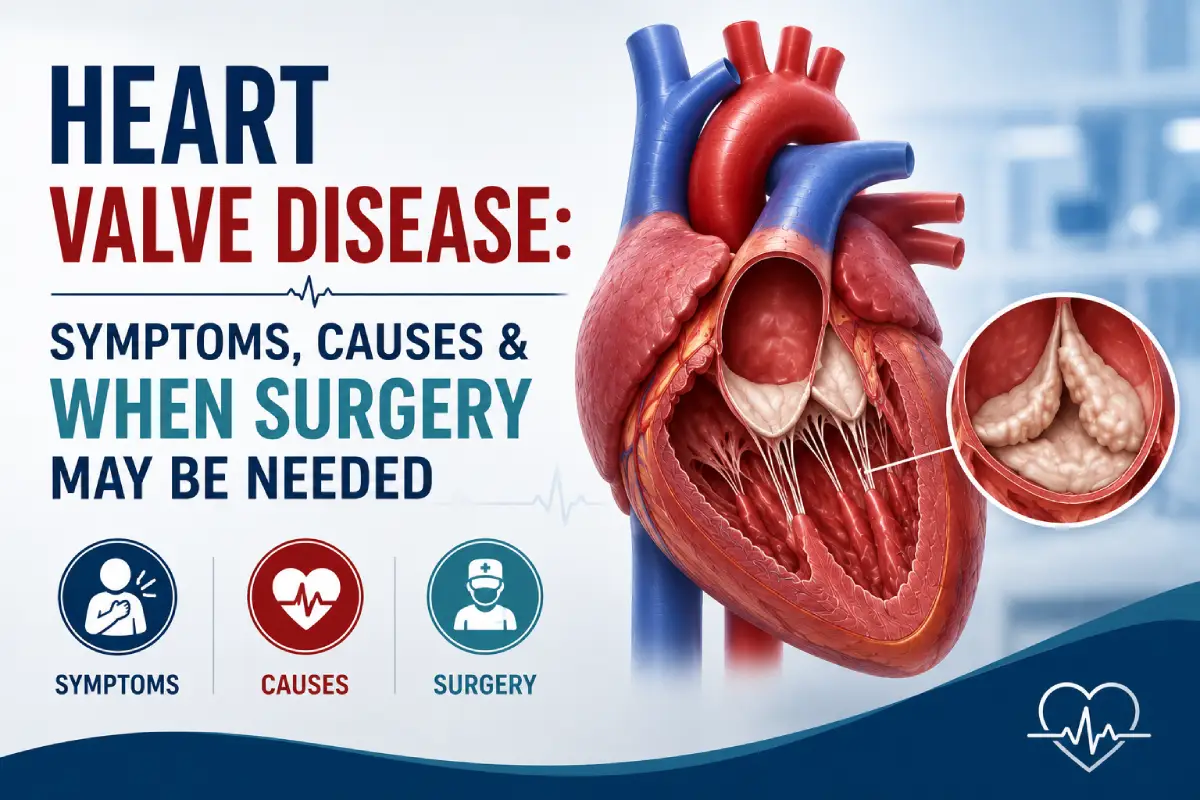
Heart valves work continuously to keep blood moving through the heart in the correct direction. When one or more valves become narrowed, damaged, or unable to close properly, normal blood flow can be disrupted and the heart may need to work harder.
Heart valve disease can range from mild abnormalities that require only regular monitoring to severe conditions that may require valve repair, valve replacement, or another advanced cardiac procedure.
Some people with valve disease have no symptoms for a long time. Others may develop shortness of breath, fatigue, chest discomfort, palpitations, dizziness, fainting, swelling, or reduced ability to perform normal activities.
Understanding the symptoms and obtaining appropriate cardiac evaluation can help determine the severity of valve disease and whether monitoring, medical treatment, or surgical intervention may be required.

What Are the Heart Valves?
The heart contains four valves that help control the direction of blood flow:
- Mitral valve
- Aortic valve
- Tricuspid valve
- Pulmonary valve
Each valve opens when blood needs to move forward and closes to help prevent backward flow.
Problems can develop when a valve becomes too narrow to open properly, does not close completely, or develops another structural abnormality that interferes with normal circulation.
What Is Heart Valve Disease?
Heart valve disease is a general term used for conditions that affect the structure or function of one or more heart valves.
The two major functional problems are:
- Stenosis: the valve becomes narrowed and restricts forward blood flow.
- Regurgitation: the valve does not close properly and allows blood to leak backward.
Some patients can have both narrowing and leakage, and more than one heart valve may occasionally be affected.
What Is Heart Valve Stenosis?
Valve stenosis occurs when a valve opening becomes narrowed or stiff and cannot open fully.
The heart then needs to generate greater pressure to move blood through the restricted opening. Over time, this additional workload can affect the heart muscle.
Aortic stenosis and mitral stenosis are clinically important examples of valve narrowing.
What Is Heart Valve Regurgitation?
Regurgitation occurs when a heart valve does not close completely, allowing some blood to travel backward instead of continuing in the normal forward direction.
If leakage becomes significant, the heart may have to pump additional blood to maintain adequate circulation. Over time, this can lead to enlargement of heart chambers or changes in heart function.
Mitral regurgitation and aortic regurgitation are common examples.
Which Heart Valves Most Commonly Need Surgical Treatment?
Any of the four heart valves can develop disease, but the mitral and aortic valves are commonly involved in adult valve surgery.
The treatment required depends on which valve is affected, whether the problem is narrowing or leakage, its severity, heart function, symptoms, and individual anatomy.
What Causes Heart Valve Disease?
Heart valve disease can be present from birth or develop later in life. Causes vary considerably between patients. NHLBI notes that valve disease may be congenital or develop because of factors such as aging or infection.
Age-Related Valve Changes
As people age, valve tissue can become thicker or develop calcium deposits. These changes can make a valve stiffer and interfere with normal opening or closing.
Congenital Valve Abnormalities
Some people are born with structural differences in one or more heart valves.
A bicuspid aortic valve, for example, has two main valve leaflets rather than the usual three and may develop narrowing or leakage later in life.
Rheumatic Heart Disease
Previous rheumatic fever can damage heart valves and lead to thickening, scarring, narrowing, or leakage.
Heart Valve Infection
Infective endocarditis can damage valve tissue and may cause significant valve leakage or other complications.
Degenerative Valve Disease
Valve tissue and its supporting structures can gradually weaken or change over time. Degenerative changes are particularly relevant to some forms of mitral valve disease.
Other Heart Conditions
Changes in heart chamber size or function can sometimes affect the way a valve closes even when the valve itself was not originally abnormal.
Previous Cardiac Conditions or Procedures
Previous heart disease, cardiac surgery, certain treatments, or other structural abnormalities may influence valve function in selected patients.
What Are the Symptoms of Heart Valve Disease?
Heart valve disease does not always cause symptoms in its early stages. When symptoms occur, they can include shortness of breath, fatigue or weakness, chest discomfort, palpitations, light-headedness or fainting, and swelling of the ankles, feet, or abdomen.
Possible symptoms include:
- Shortness of breath
- Fatigue or reduced energy
- Difficulty performing normal physical activities
- Chest pain, pressure, or discomfort
- Palpitations or awareness of heartbeat
- Dizziness or light-headedness
- Fainting
- Swelling of the ankles or feet
- Abdominal swelling in some patients
- Difficulty breathing when lying flat in more advanced cardiac disease
The type and severity of symptoms vary according to the valve affected and how significantly the disease is interfering with heart function.
Can Severe Valve Disease Exist Without Symptoms?
Yes. The presence or absence of symptoms does not always indicate exactly how severe a valve abnormality is.
Some patients adjust their lifestyle gradually and may not immediately notice that their exercise capacity has declined. Others can have significant valve disease discovered during examination or cardiac imaging.
This is why regular follow-up is important once clinically meaningful heart valve disease has been diagnosed.
How Is Heart Valve Disease Diagnosed?
Diagnosis usually combines medical history, clinical examination, and cardiac investigations.
A doctor may listen to the heart for abnormal sounds such as a heart murmur and assess symptoms, blood pressure, pulse, breathing, and signs of fluid retention.
What Tests May Be Used?
Depending on the patient’s condition, investigations may include:
- Electrocardiogram (ECG)
- Echocardiography
- Transesophageal echocardiography in selected cases
- Chest imaging
- Blood investigations
- CT imaging
- Cardiac MRI in selected patients
- Coronary angiography when appropriate
- Exercise-related assessment in selected situations
- Other specialized cardiac investigations
Why Is Echocardiography Important?
Echocardiography is one of the most important tools for evaluating heart valve disease.
It can help doctors assess:
- Which valve is affected
- Valve structure and movement
- Severity of narrowing
- Severity of leakage
- Heart chamber size
- Heart pumping function
- Blood flow through the valves
- Pressure-related changes within the heart
Repeat echocardiography may also be used to monitor how valve disease changes over time.
Does Every Patient With Heart Valve Disease Need Surgery?
No. Mild heart valve disease without symptoms may only require regular monitoring. Treatment becomes more important when disease is severe, causes symptoms, or begins to affect the heart. NHS guidance notes that severe heart valve disease commonly requires consideration of valve repair or replacement.
The treatment strategy may include:
- Regular monitoring
- Medical treatment
- Management of associated heart conditions
- Valve repair
- Valve replacement
- Minimally invasive surgery in selected patients
- Transcatheter valve procedures in selected conditions
Can Medicines Treat Heart Valve Disease?
Medicines can help control symptoms and associated cardiovascular conditions, but they do not necessarily correct the underlying structural valve abnormality.
Depending on the patient, medicines may be used to help manage:
- Blood pressure
- Fluid retention
- Heart rhythm problems
- Risk of blood clots in appropriate patients
- Other associated cardiovascular conditions
The American Heart Association and NHLBI note that medication may be used to manage symptoms or associated problems, while a valve that requires structural correction may need repair or replacement.
When May Heart Valve Surgery Be Needed?
Heart valve intervention may be considered when the valve problem becomes severe or when there is evidence that it is affecting symptoms, heart structure, or cardiac function.
Factors that may influence the timing of treatment include:
- Severity of valve narrowing or leakage
- Development of symptoms
- Changes in heart pumping function
- Enlargement of heart chambers
- Increasing pressure within the heart or lungs
- Development of certain abnormal heart rhythms
- Progressive disease on follow-up imaging
- Need for another cardiac operation
- Individual anatomy and overall health
In some severe valve conditions, treatment may be considered even before major symptoms develop if there is concern that waiting could allow progressive heart damage.
What Is Heart Valve Repair?
Valve repair preserves the patient’s own heart valve and corrects the abnormal structure whenever an effective and durable repair is possible.
Depending on the valve problem, repair techniques may involve reshaping valve tissue, correcting leaflet movement, supporting the valve with a ring, or repairing supporting structures.
Repair can be particularly important in selected forms of mitral valve disease.
What Is Heart Valve Replacement?
When a valve cannot be repaired reliably, replacement may be necessary.
The diseased valve is replaced with a prosthetic valve designed to restore effective blood flow.
Surgical replacement valves are generally categorized as:
- Mechanical valves
- Biological or tissue valves
The choice depends on age, valve position, medical history, anticoagulation considerations, expected durability, lifestyle, and other individual factors.
Mechanical vs Biological Heart Valves
Mechanical Valve
Mechanical valves are designed for long-term durability. Patients with a mechanical valve generally require long-term anticoagulation to reduce the risk of blood clot formation.
Biological Valve
Biological valves are made from specially prepared tissue. Their anticoagulation requirements differ from mechanical valves, although biological valves may deteriorate over time.
Neither valve type is universally best. The appropriate choice should be individualized.
Can Heart Valve Surgery Be Minimally Invasive?
Selected patients with certain valve conditions may be candidates for minimally invasive heart valve surgery.
These procedures use smaller surgical access points instead of wider conventional access.
Minimally invasive techniques may be used for selected mitral or aortic valve procedures depending on anatomy, valve disease, previous surgery, additional cardiac procedures required, and the surgeon’s assessment.
Can Robotic Surgery Be Used for Heart Valve Disease?
Robotic technology may be used for selected cardiac operations, particularly some mitral valve procedures.
Robotic cardiac surgery is a form of minimally invasive surgery in which specialized robotic instruments assist the surgeon in performing the procedure through smaller access points.
Not every patient with valve disease is a candidate for robotic surgery. Patient selection requires detailed clinical and anatomical assessment.
What Are Transcatheter Valve Procedures?
Some heart valve conditions can also be treated using catheter-based techniques rather than conventional surgery.
For example, transcatheter aortic valve replacement (TAVR/TAVI) can replace a diseased aortic valve through a catheter-based approach in appropriately selected patients.
Other transcatheter therapies may be available for selected valve problems depending on anatomy, disease type, and clinical circumstances.
Surgery vs Transcatheter Treatment
| Factor | Surgical Valve Treatment | Transcatheter Treatment |
|---|---|---|
| Approach | Surgical access to repair or replace the valve | Catheter-based access |
| Valve Repair | Possible for selected valve conditions | Available for selected conditions and anatomy |
| Valve Replacement | Mechanical or biological valve options depending on procedure | Biological transcatheter valve used in applicable procedures |
| Additional Heart Surgery | Other required cardiac procedures may sometimes be performed at the same operation | Usually focused on a particular structural heart problem |
| Suitability | Determined by valve anatomy, disease severity, age, overall health, surgical risk and long-term treatment considerations | |
What Are the Potential Benefits of Treating Severe Valve Disease?
The aim of treatment is to restore more effective blood flow and reduce the strain created by a severely narrowed or leaking valve.
Depending on the condition and timing of treatment, potential benefits may include:
- Improved valve function
- Improved blood flow through the heart
- Reduction in valve-related symptoms
- Improved exercise tolerance in selected patients
- Reduced workload on the heart
- Protection of heart function when intervention is appropriately timed
Individual outcomes depend on the specific valve disease, heart function, overall health, treatment performed, and other clinical factors.
What Are the Risks of Heart Valve Surgery?
Heart valve surgery is a major cardiac procedure and can involve potential complications.
Depending on the operation and patient, these can include:
- Bleeding
- Infection
- Abnormal heart rhythm
- Blood clot-related complications
- Neurological complications
- Breathing or lung problems
- Kidney-related complications
- Valve-related complications
- Need for further treatment or intervention
The individual balance of benefits and risks should be discussed with the treating cardiologist and cardiac surgeon before a procedure.
How Is the Right Heart Valve Treatment Selected?
There is no single heart valve treatment that is appropriate for every patient.
The medical team considers several factors together:
- Which valve is affected
- Whether the valve is narrowed, leaking, or both
- Severity of the disease
- Valve anatomy
- Heart pumping function
- Heart chamber size
- Presence of symptoms
- Other heart diseases
- Previous cardiac procedures
- Age
- Overall health
- Expected durability of different treatments
- Individual procedure-related risks
What Happens After Heart Valve Surgery?
After valve surgery, patients are closely monitored while heart function, breathing, circulation, blood pressure, heart rhythm, pain control, and surgical recovery are assessed.
As recovery progresses, the focus generally moves toward increasing mobility, wound healing, normal eating, medication management, and preparation for discharge.
How Long Is Recovery After Heart Valve Surgery?
Recovery varies according to the type of procedure and the patient’s overall condition.
Factors influencing recovery may include:
- Valve repaired or replaced
- Type of surgical access
- Whether another heart procedure was performed
- Age
- Heart function before treatment
- Overall physical health
- Other medical conditions
- Postoperative complications
- Individual healing response
Patients should follow the recovery plan provided by their treating team rather than relying on a fixed timeline.
Why Is Follow-Up Important?
Heart valve disease and treated valves require ongoing follow-up.
Follow-up may assess:
- Symptoms
- Heart rhythm
- Valve function
- Heart chamber size
- Heart pumping ability
- Medication requirements
- Recovery after treatment
Repeat echocardiography may be recommended to monitor valve function over time.
Can Heart Valve Disease Lead to Heart Failure?
Severe valve disease can place an increasing workload on the heart. If significant obstruction or leakage remains untreated, the heart may eventually have difficulty maintaining normal circulation.
Timely monitoring and intervention are therefore important in patients with clinically significant valve disease.
Can Heart Valve Disease Cause Abnormal Heart Rhythms?
Yes. Some valve conditions can be associated with abnormal heart rhythms, particularly when the disease causes enlargement of the heart chambers.
Palpitations or a newly detected rhythm problem should be evaluated as part of the overall cardiac assessment.
Questions to Ask Your Cardiologist or Cardiac Surgeon
If you have been diagnosed with heart valve disease, useful questions may include:
- Which heart valve is affected?
- Is my valve narrowed, leaking, or both?
- How severe is the disease?
- Is my heart function being affected?
- How frequently should I have follow-up tests?
- Do I need treatment now?
- Can my valve be repaired?
- Will I need valve replacement?
- What type of replacement valve may be appropriate?
- Am I suitable for minimally invasive surgery?
- Could robotic surgery be appropriate?
- Is a transcatheter procedure an option?
- What are my individual risks?
- What happens if treatment is delayed?
- What follow-up will be required after treatment?
Frequently Asked Questions About Heart Valve Disease
Is heart valve disease always serious?
No. Valve disease ranges from mild to severe. Mild abnormalities may require only regular monitoring, while severe disease can require repair, replacement, or another procedure.
Can you have heart valve disease without symptoms?
Yes. Some people have valve disease without noticeable symptoms, particularly during earlier stages. Regular cardiac evaluation is important when valve disease has already been identified.
Can medicines cure heart valve disease?
Medicines can help manage symptoms and associated conditions, but they generally cannot physically repair a significantly damaged or narrowed valve.
When does a heart valve need surgery?
Surgery or another valve intervention may be considered when disease becomes severe, causes symptoms, begins to affect heart function, or creates concern about progressive cardiac damage.
Can a diseased heart valve be repaired instead of replaced?
Yes, selected valves can be repaired. The possibility of repair depends on which valve is affected, the cause of the disease, anatomy, and whether a durable result is expected.
Can heart valve surgery be minimally invasive?
Selected patients can undergo valve procedures through minimally invasive surgical access. Suitability depends on individual anatomy, the procedure required, previous surgery, and overall health.
Is robotic surgery available for heart valve disease?
Robotic cardiac surgery may be appropriate for selected valve procedures, particularly certain mitral valve operations. A specialist evaluation is required to determine eligibility.
Does a replacement heart valve last forever?
Valve durability varies according to the type of replacement valve and individual clinical circumstances. Long-term cardiac follow-up remains important after valve replacement.
When Should You Seek Medical Evaluation?
Symptoms such as unexplained breathlessness, reduced exercise capacity, palpitations, swelling, recurrent dizziness, fainting, or chest discomfort should be medically assessed, particularly in someone with known heart valve disease.
Severe or rapidly worsening chest symptoms, major breathing difficulty, loss of consciousness, or other sudden serious symptoms require urgent medical evaluation rather than waiting for a routine appointment.
Early Evaluation Can Help Protect Heart Function
Heart valve disease does not affect every patient in the same way. Some valve abnormalities remain stable for years, while others gradually progress and begin to affect the heart.
The important step is to identify the type and severity of valve disease, monitor it appropriately, and consider treatment when the expected benefits outweigh the risks.
The goal of heart valve treatment is not simply to correct an abnormal valve—it is to restore effective blood flow, reduce unnecessary strain on the heart, and protect long-term cardiac function.
Consult Dr. Arunansu Dhole for Heart Valve Disease and Advanced Cardiac Surgery
Dr. Arunansu Dhole, MBBS, DNB, MCh (CTVS), MRCS (Eng), is a Cardiothoracic & Vascular Surgeon providing advanced cardiac surgical care, including mitral and aortic valve surgery, minimally invasive cardiac surgery, robotic cardiac surgery, and coronary artery bypass surgery.
If you have been diagnosed with heart valve disease, have been advised to consider valve surgery, or need a surgical opinion regarding a mitral or aortic valve condition, a detailed evaluation can help clarify the available treatment options.
Schedule a consultation with Dr. Arunansu Dhole for individualized assessment and discussion of heart valve repair, replacement, minimally invasive surgery, robotic cardiac surgery, and other appropriate treatment options.
Important Medical Information
This article is intended for general patient education only and should not be used for self-diagnosis or as a substitute for professional medical advice, diagnosis, or treatment. Heart valve disease varies considerably between patients. The need for monitoring, medication, surgery, transcatheter treatment, or another procedure must be determined after individualized evaluation by qualified healthcare professionals.